Showing posts with label delhi. Show all posts

Wednesday, 11 September 2013

Urban solitude

Place: DELHI

HOTEL: DUSIT DEVARANA

An uber luxury urban resort, the first in its kind in the National Capital Region, is how you are introduced to the hotel. Let’s see if the facts and features impress you. The resort is spread in about eight acres. This vast spread however has just 50 rooms, the average space per room is considerable. All rooms, and there are three categories of each, are sized 650 square feet each. Room amenities include all the clock butler service and iPads to control for all gadgets. There’s a 102 metre pool – that’s more than twice the length of an Olympic size pool,  between the blocks set amongst landscapes gardens. There are over a 1,000 trees on the property.

The entrance, though on the National Highway 8, is discreet, so be on a lookout for it. Design fans, start taking mental notes. The Thai colour for royalty, purple starts right here, and is woven into multiple facets of the hotel. You drive into a square, spacious courtyard, where guests are dropped off. Note the walls – besides acting as a sound barrier, their surface is covered with metal ficus leaves, in effect a huge art installation. The architect, the renowned Lek Bunnag, who has also done the Four Seasons Resort in Chiang Mai and Langkawi, the Sofitel So Mauritius and the Oberoi, Bali, besides the Trident, Gurgaon, has chosen to keep the interiors minimalist, creating spaces of serenity.

Wander further, and an imposing door opens to what is referred to as the ‘dome’ building. Though you won’t get a clear line of vision here – intentionally - pause a moment to take in the intricacies of design. Note the boat shaped marble tables, the strikingly hued glass panel, the net and glass topped ceiling, which filters light to reflect the different times of day creating shadow play, the beautiful moon doors, recessed niches and arches set in stone, clover leaf patterns – a motif that goes across the hotel. This area opens to a long pool with hugging greens and a family of friendly ducks!

Dusit Devarana is positioned as a luxury spa destination, says Ankur Bhatia, Executive Director, Bird Group. “We would like to serve the discerning tourist who wishes to enjoy a luxurious residence while in India.  The top-end of the corporate sector will love staying here too with our superb location near the airport and excellent, quick access to Gurgaon or important addresses in Delhi.”  

The built up area, just 2.6 acres, comes mainly in two blocks. The northern block, besides rooms, which include 11 Grand rooms that open to the pool, providing private access to it, also houses Lah. Though there is no official word on the expense incurred to develop the resort, just the fact that every detail has been minutely debated makes it a delight for the customer. Birgit Holm, General Manager, who has been on the project for the last two and half years, takes pride in pointing out details such as the beautifully carved door handles, moon doors or the bird topped receptacles in all rooms. Staff uniforms have been designed by designer Suneet Varma, and staff to guest ratio is about three and a half.

The outdoor pool is temperature controlled. The marble used is from Greece. Terrazzo has been widely used for surfaces, and there is a fair amount of work in bronze and brass, though largely understated. The design incorporates local motifs as well, as well as those from the past, including the Isfahani pillars in hardwood. All public areas have ceilings that are 25 to 30 feet high, helping to create a spacious feel, adds Jaideep Anand, AGM. The ambience for the property is uniquely serene for a bustling destination such as Delhi, though there are parts where the summer sun maybe a tad too much even for a short walk!

The southern block is fronted by a set of gigantic stone columns inspired by those at Elephanta caves, and open to a restaurant. Dining options include Kiyan, which offers world cuisine, and you will be grateful for leaving that diet behind during your stay, for Executive Sous Chef Nishant Choubey conjures up some magic on the table. There are no buffets, instead chef has opted for set meals delivered out of a no expenses spared fancy kitchen. Attention to detail is evident in each dish, both in presentation and the flavours. Expect charcuterie platters and quinoa! Add the amethyst wall and an exquisite metal tree by product designer John Bowman, and no surprises that this is likely to be the focal point of stays here.

Iah, the bar caters to younger clientele, offering trendy mixology options, boutique brewery beers and new age wines. An added destination will be Kai, the Mayfair London based Michelin starred restaurant serving Chinese cuisine. It is expected to open later this year. It’s going to be in an outdoor luxury tent next to the southern block.

With the Thai tradition to excellence to uphold for its spa, the azure and silver Mughal design themed Devarana Spa also has a lot riding on it. There is a block for meetings and conferences, though the hotel is quick to admit it will only be able to host up to a hundred or so people, ruling out the mega Indian wedding. A more intimate social function or top end corporate meeting is more the target.

Room interiors are as noteworthy - the designers have certainly pushed the envelope: many rooms feature a bathtub directly adjacent to the couch and the French windows, the day beds are enticing, the amenities are from Asprey’s Purple Line, the washbasins appear more like oversized flower vases.

The hotel has been about four years in the making, and is opening with a delay of about a year, less than average compared to hospitality projects in the country. Room rates for Dusit Devarana compete with the top end local hotels, though serving a very different clientele. Hospitality experts feel the hotel could set new benchmarks for urban resorts in India, though the current slowdown in the economy could impact its initial occupancy and room rates. 

Wednesday, 14 August 2013

Party with the rich


Place: DELHI
Pangaea’s entry into India brings elite party level closer home

This is Michael Ault’s 89th club opening. He asserts this is his best yet. Ault’s penchant for opening top end clubs has seen him being labeled as the ‘king of New York nightlife’. While the Pangaea in New York is no longer open, it was the byword for being the ‘hottest party in town’, attracting a heady mix of wealth and celebrity as they let their collective hair down. The opening of a underwater branch at a spectacular ‘crystal’ island at Singapore’s Marina Islands about two years ago brought the ‘ultra-lounge’ so much closer home for India’s jet set.

Here’s a little known facet of Pangaea, Singapore. About 30 per cent of entrants to the Singapore Pangaea are Indians, the largest number by nationality, say club spokespersons. It was no surprise that Ault was more than willing to come to India. The club in Delhi has just opened at Delhi’s ITDC run Ashoka hotel, and a second one is slated to start in a hotel in Juhu, though the group is coy in naming the exact location!

Old wealth, new skins
Ault, 50, and a collector of rare Louis Vuitton handbags and an avid scuba diver is no playboy. Born to old money, his chosen business happens to be clubs, which he started after a six-year stint at Wall Street. These clubs, and besides Pangaea, he also owns Spy, Chaos, MercBar, Prive and Nocturne, are reputed to be some of the top revenue earners in business that is notoriously fickle as the clientele shifts to latest hotspot periodically. The average per head spend at Pangaea is anywhere from $400 to $1,000, says Ault. Pangaea Singapore earned $21 million in the first year of operations.

He is most bullish on India, saying the kind of money that Indians spend often amazes him. “You have to look at them twice to believe it,” he says.. While neither he nor Ozi Amanat, President and Chief Investment Officer, Spice Global, the BK Modi owned conglomerate that is now spreading beyond telecom, will reveal the exact spend, most estimate it to have cost ‘an arm and a leg’ metaphorically! Spice signed a one year contract with Pangaea, and Amanat says the scoping and benchmarking process has left him confident that India’s first taste of a global nightclub will work wonders for the bottomline.

“We can recover money very very fast in this business,” says Amanat. A week into opening, he is already pleased with the returns from the 6,000 square feet club, (F-Bar was previous occupant of the space) with seating for about 250 people, with  and another 250 standing. “There is no separate floor for dancing,” explains Amanat, as is the club’s practice elsewhere. “People can dance where they like, and keep ordering drinks!” Splurging will come easier for the ‘loaded’ in India. The top entry price is Rs 4 lakhs, though considerably lower entry fees also exist! The Jewel of Pangaea cocktail in Singapore costs about $28,000, and Amanat says there will a signature one like that in India soon! 

If that doesn’t keep it in the limelight, an impressive line of events including a DJ KasKade night should ensure to make it a much sought after ‘watering hole’ for the city for quite a while. A dozen hostesses from different geographies adds to exotic element, while a number of innovations including soundproof walls. Amanat is aware of the challenges, such as early closing times in India, but is confident that the club will do well. Indians eat post clubbing so the available menu that ranges from chicken tikkas to mini wagyu burgers could be expanded. Private events are also expected to shore up revenues. There are no plans to expand beyond Delhi and Mumbai, but once inside Pangaea, India’s partygoers could be forgiven for thinking they were in a more global party capital such as New York, London or Miami.

Wednesday, 5 June 2013

Travels by aquatint


Place: COLONIAL INDIA

Book:
DANIELLS' INDIA: Views from the eighteenth century
Introduction: B N Goswamy
Niyogi Books
Pages: 204 
Price: Rs 6,000

Professor Mushirul Hasan’s tenure at the National Archives ended recently with the release of particularly significant work – the publication of a book consisting reproductions of exquisite aquatints by the famous English uncle-nephew duo Thomas and William Daniell.  These are part of the collection at National Archives, and present an unparalleled view of late 18th century India- a time of fervent and major changes in directions for India’s polity and economy.


The Water-fall at Puppanassum in the Tinnevelly District  
Not that this is overtly visible in their tranquil depictions of India. When they came to India, after seeking and getting permission of the ‘Honourable Court of the Directors of the East India Company’, Thomas was 36, his nephew William barely16.  They set sail to India in 1785, reaching Calcutta next year. The British Raj had firmly established itself, with the East Indian Company armies winning victories over rulers in Bengal, the south, the Marathas and the Mughals and finally Tipu Sultan’s Mysore.  


The Writers’ Buildings, so called from being the residence of the junior
part of the Gentlemen in the service of the English East India Company.
 Immediately beyond this Edifice is the old Court House; the road leads
on to the Loll Bazar; the obelisk was erected by Governor Holwell,*
 in commemoration of the dreadful circumstance which
happened in the prison called the Blackhole in the year 1756.
Thomas Daniell, as was the custom, on reaching India, advertised in the Calcutta Chronicle that “he proposed to publish twelve views of Calcutta at twelve gold Mohurs the set... there was demand for this kind of work, for the British, potential subscribers, loved the city which had grown to be ‘not only the handsomest town in Asia but one of the finest in the world’”.  Considerable success later, the duo were drawn to go into the hinterlands – up the Ganga, to Murshidabad – the original home of Company Paintings, and then onwards to the leading cities of the time - Patna, Kanpur, Agra  and Delhi, returning to Calcutta only in 1791. Over eight years, they made three major journeys – after travelling up the Ganga, they went south, basing themselves in Madras and traversing the southern parts of peninsular India. The last journey took them to the west, covering Elephanta, Kanheri and Salsette among others.  


THE ENTRANCE TO THE MAUSOLEUMS IN SULTAUN KHUSERO’S GARDEN, NEAR ALAHABAD: This gate is the principal entrance to the garden in which Sultaun Khusero, his mother the Ranee, and his brother Sultaun Purveiz, are interred. Though a massy structure, it has by no means a heavy effect; and though it formerly may have appeared with more splendor, having been painted with different colours, that surface is fortunately now nearly washed off. The upper part towards the garden is much decayed.  
THE JUMMAH MUSJED, AT DELHI: The Jummah Musjed, or Friday’s Mosque,
 is the principal place of religious worship of the followers of the
Mahommedan doctrine in India. This edifice was built by the Emperor
Shah Jehan. The domes, and all the other parts which appear white,
are of Cashmerian marble, the rest of red stone procured in the
neighbourhood of Delhi. In regularity of design and correctness  of
execution this building is considered of the first class. It is approached
by three magnificent gates.
Their itinerary was exhaustive, and the geography covered extensive - from Garhwal in the north to Kanyakumari in the south, and often took them to places no one had recorded earlier. Their works are remarkably detailed, much in the style of Canaletto, and possibly in tune with William Galpin’s contemporary Picturesque art, which concentrated on landscapes. Indeed the landscapes that the Daniells have depicted in their works are of a romantic, mystical, exotic India, an image that persists to this day. Thomas Sutton quotes a glowing tribute to the artistic work of the Daniells, “The execution of these drawings is indeed masterly; there is every reason to confide in the fidelity of the representations; and the effect produced by this rich and splendid display of oriental scenery is truly striking. In looking at it, one may almost feel the warmth of an Indian sky, the water seems to be in actual motion and the animals, trees and plants are studies for the naturalist.”


TREMAL NAIG’S CHOULTRY, MADURA: The Choultry of rajah Tremal Naig is considered as one of the first works of its kind in the south of Hindoostan. Its general form is that of a parallelogram, three hundred and twelve feet in length, by one hundred and twenty-five feet in width; and consists of one large hall, the ceiling of which is supported by six ranges of columns, about twenty-five feet in height, many of them formed of single stones, and the whole composed of grey granite. This view contains half the centre ile. On the second pillar to the right hand is the effigy of the rajah with three of his wives, to whom, for his munificence, the Hindoos still continue to pay divine honours. Beyond the rajah, and on the pillars opposite to him are other statues representing his family. In the ceiling are the twelve signs of the zodiac; and a number of mythological figures carved in basso relievo, are interspersed through the building, which, together with a profusion of other decorations, are executed with an uncommon degree of skill and attention.
Their work is dominated by stunning details – of palaces, forts, cities, baolis, hills, valleys, masjids, pavilions, ghats, temples, waterfalls, even a pagoda. Ruins had a special attraction, as did the nature itself. There is the bounty and splendour of nature (see The Water-Fall at Puppanassum in the Tinnevelly District), meticulous reproductions of architectural details (Tremal Naig’s Choultry, Madura – okay, let me translate - a choultry or reception hall for pilgrims built by then ruler Tirumala Nayak in 1635 in Madurai) or the everyday flow of life (view of Chitpore Road, Calcutta). The scale is usually majestic, and people are usually almost props, used to highlight the scale of the surroundings.


View Near DARAMUNDI, in the Mountains of SERINAGUR
The story of printmaking has been a long one, and aquatints were not one of the simpler techniques. The uncle nephew duo must have endured a lot during their back breaking, even pioneering journeys. Goswamy mentions that the painters themselves form part of the works occasionally. We see them from the back painting outside the fort at Bijaigarh, hunched over, holding a long telescope, next to a snoozing dog, shading themselves from the sun, both with hats and small canopy held by two servants. They are seen discussing in a group outside the palace at Madurai. It is impossible to calculate just how much the knowledge of the country was improved by their work, recording an India that not many knew existed.

It is good to note that they did well financially from their exhausting efforts. When they undertook their second journey - to the south, they were accompanied by a more extensive retinue of “two palanquins each with bearers, two horses and grooms, a bullock cart and three pack-bullocks, seven bearers to carry provisions, two porters to carry their drawing tables, besides several personal servants”. London saw richer rewards once they returned and published Oriental Scenery.

Today the duo are more than just a footnote in the fascinating story of the subcontinent. You may have seen their work at Victoria Memorial in Kolkata, or enjoyed their detailed craftsmanship over a drink at Daniells’ Tavern, named after them, at Delhi’s Imperial hotel. This book brings it closer home, the book’s excellent reproductions – compare it to HD in print if you like, and production quality, makes it a great pleasure to pore over the finer details of each painting. Most of the captions are detailed, and while original captions and spellings are used, there is a glossary at the end that makes sense of most names. Well for most. Yes, Bahar is Bihar and Cannouge is Kannauj, but there is no clue to ‘Chevalpettore’, ‘Dhuah Koonde’, ‘Siccra Gulley on the Ganges’ and some others! Perhaps a note on the places or map of their itinerary would help research follow the trail to these exotic destinations. And perhaps a CD of the works!

Friday, 5 April 2013

A place of beauty

Place: DELHI 


Innovatively designed bookshelves add to Oxford
Bookstore's considerable attraction
Shop: 
OXFORD BOOKSTORE 

Pristine white with artistic touches of colour. Heritage architecture, modern arches. A large, expansive, beautifully lit space with dining on the side – none of these are how most Indians would describe a bookstore. However entering the newest outlet of the Oxford Bookstore is a wow moment. In an era when bookstores could become history, it is a space where one wishes time would stop. While all around you are books of every shape, subject, size and shade, the store is also as much about aesthetics and the fusion of the need to cater to the mind and the senses. 

A pan India chain, that began in 1919, Oxford Bookstore had already introduced merchandise, events and dining spaces to their beautiful stores. The recent relaunch of the store in Delhi, in the heritage zone of Connaught Place, just across the road from where its earlier store was, had everyone in attendance just taken aback at the beauty of the store. 

“Through a painstaking restoration of the majestic architecture and a careful curation of the heritage spaces, we have carved out an incredible space for quiet browsing, reading and contemplation,” says Priti Paul, Director, Apeejay Surrendra Group. Just about every writer, retailer, agent, publisher and distributor came to grace the occasion. “It is a beautiful store," says Bikash Niyogi, MD, Niyogi Books, who predicts that it would be one of Delhi’s favourite hangout places. 

Prettiness is the dominant theme at the store
This store has been long in the making. “We looked at a number of locations,” she says before deciding on this one, a run-down place with false ceilings. She was clear that she wanted the store in the historic centre of town, and Connaught Place. “The restoration of the store tied in well with the restoration of Connaught Place. I felt I had to do something for the restoration of the historic area. Lots of people thought I was crazy to choose CP over the newer areas, but I was sure of my decision.” While she will not reveal how much it cost to redo, indeed restore, the 5,000 square feet store, Paul, an architect herself admits to be nervous before the opening about the acceptability of the design. “We discussed various looks, including a kitschy Indian one, and I had been thinking for long about the future of the bookstore. Delhi is about Punjabi Baroque, I was fairly extreme in my choice of white with the store,” she says. 

The neon wall in itself makes any visit special 
Oxford Bookstore is part of the Apeejay Surrendra Group, which has interests in shipping, tea, real estate, logistics and hospitality. The chain now has 16 outlets in nine cities in India. Besides the downtown stores, other formats include Oxford Junior and Oxford Express, both launched in 2006. “We have a lot of formats. Bangalore already has four formats, including one in the WIPRO campus.  The chain is expanding on its own and by franchisee outlets. 

Paul however is reluctant to talk about the chain’s future business plans. “I see a present need for bookstores,” she points out. She agrees that retail is difficult at the moment, and most of the positioning in the sector is for the future. “The dynamics of the market are changing, and while we do not what the future holds, but in India, people will still need to buy books. Competition has increased in the form of new chain stores have now come up, such as Landmark, Om Books, Crossword, Timeout, but few have ventured to being a cultural hub that the Oxford Bookstores have positioned themselves into. 

A lovely space for events is sure to add to the charm of the store
The chain, a completely integrated online offline bookstore in the country with access to six million titles worldwide, is among India’s leading stores, and has led in innovations over time. It was the first book retailing enterprise in the country to launch an interactive SMS Service in association with Mobile 365 while Oxford Über is India’s only exclusive store for lifestyle books. Paul is not a fan of soul less chain stores. “The new bookstores should be “breakaway spaces, interactive and entertainment spaces that will promote literature with related cultural and reading events – a combination of books, art, fashion, culture and food,” she says about her store.

Innovative steps also include the chain tying up with the World Wide Fund for Nature, to fund the One-Horned Rhino Conservation Project. “We will reach out to individuals of the younger generation through books and programmes to make for a better natural environment,” says Ravi Singh, secretary general, WWF-India.

Priti Paul resplendent in a
Sabyasachi saree  at the relaunch
of  Oxford Bookstore in Delhi
Paul has put a special focus on translations. Not only is there a separate section for it, it is next to Indian fiction in English, a prime position for the store. Paul feels that while Indian writers writing in English are getting their due, those writing in other Indian languages are still languishing behind. With a list of 1,000 translations, 500 in store, and with translations sourced from the global market, Paul is going all out to get the Indian reader look at translations. She has signed a distribution deal with indie publisher Katha, known for its work in translations. 

The store is getting rave reviews. No wonder Paul is beaming. She had planned a three-day stopover in Delhi after the opening of the store, and ended by staying for three weeks. “I am overwhelmed by the response to the store. People have been calling up constantly to sign up contracts, discuss deals, plan events… I had to run away home,” she says. Home is Morocco, where she has returned after two months in India. Incidentally, OBS also has an outlet in Morocco, Kathakali, which caters to African, French, English literatures, besides introducing Indian writers to the region, and which she opened last year. But it is her newest Delhi store that has excited the most. “I was offered so much, I could have tied up my calendar till next year,” she says. Enviable start for a book store! And there’s more to come, watch this space.

DECONSTRUCTION, BOOKSTORE STYLE
The spectacular Cha Bar is sure to be a meeting point for fans once again
Cha Bar, the dining area, arguably offers the world’s largest assortment of teas and cultural tea preparations, and continues the heritage theme of the rest of the store, and also in white. 
Neon Wall, a cloud of words in English-Hindi-Latin that envelopes book lovers in a universe of emotions linking them to reading

Reading Room, a place where guests can read at leisure, especially young ones. Also a space where events can be held. 

While all the regular sections – fiction, travel, management and all the rest are there, an interesting section is translations, a section not usually found in stores any more, is a highlight as the chain seeks to promote books in various Indian languages and their translations. The store unveiled the section on ‘Translations and the many Literatures of India’ with a one day symposium on ‘The Many Voices of Indian Literature’. 

Wednesday, 29 February 2012

PHOTOESSAY: Assault of colours

Place: DELHI
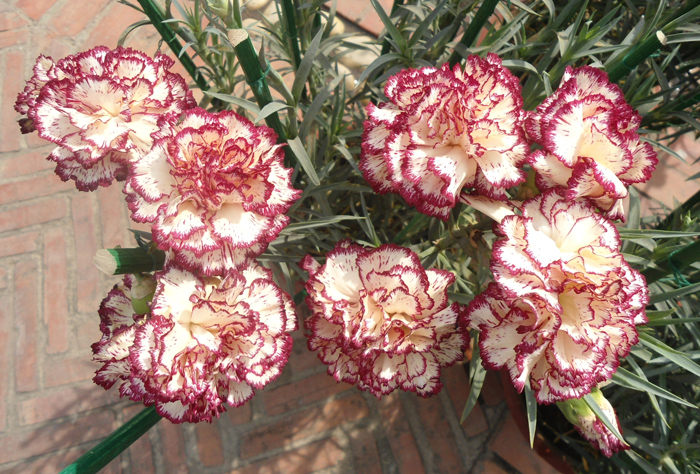
The Garden Tourism Festival is an annual pilgrimage for us, thanks to my mother's insistence. Held annually   over the third weekend of February, the festival is timed to show of the season's prolific floral outpouring at its best. Dahlias, geraniums, azaleas, pansies, chrysanthemums, daisies, gerberas and a whole lot more whose names remain unknown to me.

That brings me to my grouse over this festival, since I have been seeing it from its early years at Talkatora Gardens, it has remained fairly static in its format. There are potted plants usually sent by Rashtrapati Bhawan and a handful of corporate houses such as the Munjals, who bag almost all prizes. There are hardly any new names. The labelling is poor, with not even the names of flowers mentioned! The labels only mention the category of prize and rank, so you may read labels like - 'Garden Perennials - Second Prize', and be non the wiser on what the flowers actually are.

But anyways, flowers are always a delight, and my mother's love for them ensures we go every year, if only to buy plants for our terrace garden.

Here is a look at some pics from 2012's edition:


Purples are a favourite among flowers and gardeners clearly. A huge variety of flowers in numerous shades light up the show in royal hues.


Thursday, 19 January 2012

Future auto

Place: DELHI

Will this be the nemesis of the Indian auto? The much used and vilified auto has been a staple in the largest Indian cities for decades and has been to blame for a lot of the confusion in traffic movement.

Well, actually the RE60 is made by the same company that supplies the autos - Bajaj.

The RE60 was showcased at the Delhi auto show 2012 for the first time. The owner Rajiiv Bajaj refuses to describe it as a car, instead just repeatedly stressing that it was a four wheeled drive.

It is expected to take some time before it will be on the road. Just that it is a four wheeled vehicle should be a great relief to Delhi's traffic, who need a break from the autos. 

Monday, 3 October 2011

Devi family

Durga in the middle with here children, from left to right - Ganesha, Lakshmi, Saraswati and Kartik. Works of art, today there are a many competitions to see who can make the best idols. And competition is fierce! 
Place: DELHI

It's that time of the year again - chuti from office, lots of food, pandel hopping, all kinds of finery, mughlai porota, parar baccha der natak, prosad bitoron, raate cinema dekha, shokaler anjoli and, I almost forgot, the customary nod to Durga and her progeny.

Durga Pujo is the most anticipated time of the year for Bengalis, wherever they are. It is held usually in October, and exact, as every date in the Hindu calendar, differs from year to year. 

This is a glimpse of the devi in a pandel in Delhi's Dwarka Sector 4. Such temporary idols of the the goddess spring up four days right across the city - there are thousands now, and all over the world where there are Bengalis, or Bongs. 

For those who enjoy it, these are four days of bonding as few other communities experience it. They look forward to it the entire year, and in less materially prosperous times, it was the time of the year when new clothes were bought and worn, new activities undertaken as it was an auspicious hour. And for some, it was also the time to go on vacations as a month long holiday in Bengal meant freedom to travel! 

Kolkata of course is where the biggest celebrations are, and the city grinds to a halt during those four days. There are thousands of pandels, and people constantly travel to see idols in different pandels, visit relatives and friends, renew bonds and come together to celebrate the goddess and each other. 

Tuesday, 16 August 2011

Fire in the sky

Place: DELHI

At least that seems to be the case. It seemed as if flames of fire would simply devour the entire sky and leave nothing to see next morning.

The skies at sunset somewhere in west Delhi.

Tuesday, 15 March 2011

Motoring jewels

Place: DELHI

Cartier reaffirms its affinity with India with an ambitious vintage car show as it looks to grow its Indian market

Classic cars came up one by one to claim
their prizes at the Cartier Concours d'Elegance
 
India’s elite have long enjoyed their favourite equine speedsters win races at Delhi’s Jaipur Polo Grounds. On a recent pleasantly sunny Saturday afternoon however, the horses were replaced beauties from another era, and species, as 56 vintage cars competed for honours in the second Cartier Concours d'Elegance in India. On hand were not just vintage car enthusiasts but some leading car collectors and experts from across the world.

Cartier and India have had a long, though interrupted, love story, dating back to the days of the erstwhile maharajas. It is no surprise therefore that despite India’s current negligible share in global sales that the world’s top jewellery brand, or maison as it prefers to be known as, sees India as an important potential market that needs to be nurtured so that it can deliver up to a tenth of global sales in future.

A winning beauty roll up 
“India is in love with jewellery and its aesthetics have influenced Cartier over time,” says Bernard Fornas, President and CEO of Cartier, who was in Delhi for the Cartier Concours d’Elegance, one of the four big concours globally. The Cartier Concours d'Elegance is globally positioned as the ultimate show of motoring grandeur. The first in India was held in Mumbai in 2008, and contributed considerably in introducing new local clients to Cartier, whose largest sales in the country come in watches and jewellery.

The maharajas had wanted not just the best, but also often wanted their pieces to be unique, and that was reflected in the number of unique customized cars on show among the cars selected by Manavendra Singh, curator of the Cartier Concours. And that reflects still in the jewellery that Cartier, now part of the global luxury conglomerate, Richemont, is selling in India.

This one belongs to the erstwhile royals of Mayurbhanj
“There is great potential in India, but the taxes are an impediment,” says Fornas. Cartier opened its first 300 square metre boutique at Delhi’s Emporio two years ago, and has since been looking for other locations to open in.

India’s share in global sales are still a very small percentage, though Fornas declines to disclose figures. While jewellery is a great love for Indian women, watches also contribute an equal share for India in revenue, he says.

Various challenges remain. “A boutique in Mumbai would be good,” says he, pointing out that while there were no set rules for a store location, the overall environment and central location were crucial for any potential store site. A high street works as well as a mall, Fornas points out, pointing to the success Cartier has had in China, where weather can be a challenge too. Cartier today has 37 boutiques in China, which range from 400 to 900 square meters in size. And China could be Cartier’s largest market, a growth story Fornas would like to see replicated in India.

Louis Ferla, Cartier MD for Middle East and South Asia, says the Indian market for Cartier has grown by 30 to 40 per cent in the last three years. “The boutique is doing well, but high import duties and lack of a high street are impediments to the growth story in India,” he says.

He also admits that Indian customers have traditionally gone for local jewelers, though he is encouraged by the response international jewellery houses are getting of late.

In India, even as Cartier waits to open more stories, Cartier is investing in communication and staff besides of course events and car restoration. Even ‘The Best Car of the Show Award’ went to a historic 1911 Rolls Royce Silver Ghost Dome Roof Limousine, a throne car that belongs to former princess Ezra of Hyderabad, which Cartier helped restore to its original form. Whether the cars spur more Indians to try out Cartier timepieces or jewellery remains to be seen.

Monday, 26 July 2010

Game changer

Place: DELHI

A Maruti convertible? That was the first I had ever seen. Unfortunately this one seemed like it was on its way to the scrapyard.

Today the Maruti Suzuki 800 is being phased out, but for well over a decade, it was India's biggest selling car.

It opened up new dreams for middle class Indians, and I still remember when the first cars came in the 1984, in sky blue, maroon, canary yellow etc. A basic car, nevertheless it was almost heaven sent for those tired of the earlier Ambys and Fiats.

It has played a huge role in reshaping modern India, and is still remembered fondly by many. 

Thursday, 28 January 2010

I love my India

India Gate is lit for a Republic Day celebration 
Place: DELHI

Still one of the most evocative and emotive symbols of India, India Gate is today a symbol of hope for many, a rallying point for those wishing to make their voice heard.

Ironically, built in 1931 not only by India's former colonial masters, and to commemorate the loss of lives of India soldiers in foreign wars of the First World War, it had little to do with India's common folk. For the British at that time had not even imagined they would be out of India the next decade, as they went about building a fancy new capital for themselves.

It has since been appropriated in modern India's nation building fabric completely. Annual parades to the country's honour are held with it as a focus, and the nation's top military and political leadership pay regular homage to it.

For me, and for thousands of Delhiites, it has also been a favourite evening hangout place. I lived about a kilometre away for a considerable part of my life, and remember the countless number of times we went to it for just a stroll topped by an ice cream without caring about its legacy.

Ambitiously designed, it is today a focal point for tourism to the city. The statue of King George VI was removed after independence, and instead an eternal tributary fire is lit for the Indian soldier. 

Wednesday, 25 February 2009

Flowerworld

Place: DELHI

This is the annual flower show at the Garden of Five Senses, organised by Delhi Tourism. It used to be earlier held at the Talkatora Gardens, but has since shifted. This is in 2009, one of the first years at the new venue.

This is a flower show rather than a garden show, so basically there are a lot of potted plants. Lots of spring flowers multihued, in many shapes and sizes, make this a great visit for the average visitor. For a flower expert, not so much!

For more pics click here