Place: CHENNAI
For over a millennium, the Chola royal power held sway over much of southern India. The grandeur of their structures holds visitors spellbound even today. So it is not surprising that as ITC Hotels, one of India’s largest hospitality groups makes a push for greater prominence, they make a statement that reverberates with Chola grandeur and royal lineage in Chennai.
Whether it will it usher in a new era of hoteliering in India, just as another hotel in another coastal city by a bay did more than a hundred years ago, remains to be seen. However this hotel has the scale and and the ambition to be a game changer. It is however difficult to comprehend ITC’s newest and biggest hotel, the Grand Chola without going into getting into some numbers.
 |
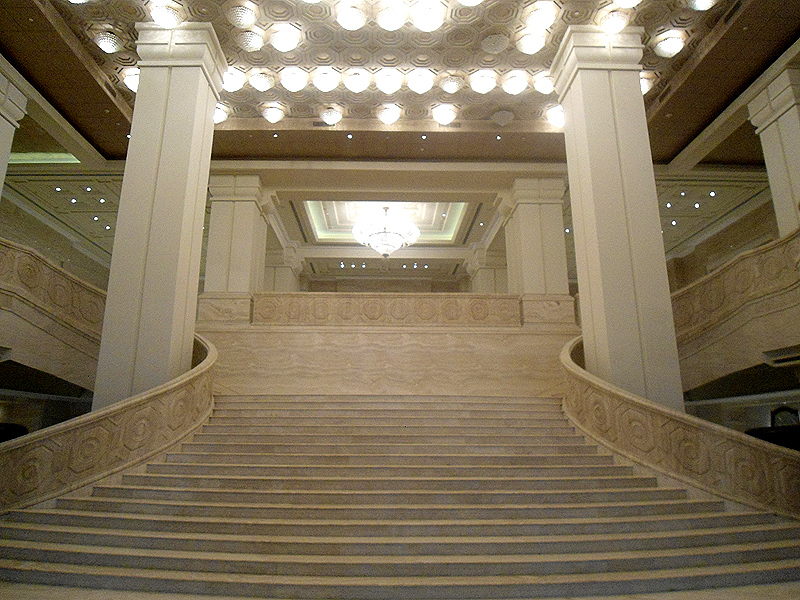
| The Sangam staircase is as impressive an entrance as any in India |
Built at a cost of Rs 1,200 crore, this 600-room hotel, spread over 1.5 million square feet in an eight acre plot, one of the largest to date in India, promises to change Chennai as a destination by significantly adding MICE (meetings, incentives, conferences, exhibitions) capacities to the city. It has 100,000 square feet of banqueting and convention space which includes 30,000 square feet of pillar-less ballroom, named after one of the greatest Chola rulers, Rajendra. It is another matter that this seemingly unending ballroom, in which one cannot see from end to end due to the slight curve of the building, can be divided into eight individual ballrooms and can accommodate 2,500 people.
 |
| Rajendra is the largest banquet hall in the city |
This hotel is slated to alter the tourism and convention landscape in the region, ITC group chairman Yogesh Deveshwar had said at the launch of hotel complex in Guindy, which was inaugurated by the Tamil Nadu chief minister J. Jayalalithaa. MICE accounts for about 10-15 per cent of the city’s total hotel demand. Growing that the segment will be a challenge, admitted Deveshwar.

Nakul Anand, Executive Director and head of the group’s hospitality division said, “The Grand Chola is ITC’s tribute to Tamil Nadu and an iconic asset for Chennai, as an archetype of the culture and ethos of the region. The grandeur and unique attributes of the hotel will provide a fillip to the hospitality sector in Chennai in addition to transforming Chennai into India’s convention capital.” Chennai, more a gateway to south India than a genuine tourism destination itself in the past, in recent years has seen the growth of industrial hubs in its periphery, with significant presence of sectors such as IT, auto, shipping, leather, woodwork, FMCG, etc.

That it might. The hotel, the ninth in ITC’s Luxury Collection and part of global chain Starwood, reportedly even left the Chief Minister spellbound. After rumoured delays in allocating time for the inauguration, J Jayalalitha spent about the double the allocated time as she toured the expansive property, even though the state government reportedly denied permission for a planned helipad last year. The hotel, which has opened partially, is expected to finally employ over a thousand personnel, while about four times the number have worked for a number of years to realize this dream in concrete and imagination. With four separate entrances, and three wings, with the first housing Executive Club rooms, while the second wing has ITC One rooms, Towers rooms and all the suites and the third wing is for long stay residences.
 |
The Lotus Lounge, an undemarcated area where one cannot hear outside noises, is a modern
application of Chola technology |
Design antecedents
Those coming in from the main or West entrance for a meeting or convention could straightaway take a choice of extensive escalators from the pre lobby area, but would impressive the grand staircase in the main lobby, called Sangam, and reminiscent of magnificent palaces of yore. It used Traventine Romano Classico marble, interspersed with symmetrically arranged pillars finished in elegant white stucco, reminiscent of the temples of South India.
 |
Rich detailing and numerous nods to the region's
history make this hotel a delight to explore |
The architects, Singapore-based Smallwood Reynolds Steward & Steward LLC, have used Chola architecture as the inspiration for the façade and motifs in the hotel. Once inside, take note of Thanjavur’s Brihadishvara Temple inspired pillars and wall textures. In contrast to the rich mélange of the exterior façade, the walls in the interior are serene, almost sparse, and in neutral tones, lending an added feeling of serenity across this vast hotel. Visual leitmotifs include carved elephants raising their trunks in veneration, the Wheel of Life or Chakra, the four petalled clover floral motif and the intricate fretwork on panels and columns—each chosen for its relevance to Chola themes. And impressively, they have been hand carved by artisans from Mahabalipuram! Among the materials used are stone, granite, marble and wood. Note the impressive backlit onyx marble at the bell desks, though in other parts of the hotel the marble has been sourced from distant parts of the world, including Italy, Spain, Morocco, Turkey India, China and Pakistan.

Understated may the language of the hotel interiors, but look out for the individual works of art. A spectacular bronze and copper horse in the lobby is a reminder of Chola valour. Large urns in deep brown and black grace the entrance to the lobby. These water urns were traditionally used to store water during summer months, and today are meant to symbolise the concept of responsible luxury. Pillar designs are sourced from Gangaikondacholapuram Temple. Door handles are exquisite metal peacocks in pairs. Even the exhaust in The Madras Pavilion is in the shape of a lotus! Water design elements are comparatively scarce, though there are three pools over the western entrance atop the banquets. Innovative features include a 'lotus lounge' an undemarcated area within which you can hear echoes but not a foot outside of it, a modem application of Chola technology.
Food destination
 |
| Cafe Mercara's warm interiors |
When finished, the hotel will have 10 food and beverage outlets, offering a variety of cuisines, which includes the outlets the group is hoping will later expand to other hotel properties, including a fine dining Italian restaurant Ottimo, whose cooking range alone costs a crore, along with Madras Pavilion, a three meal buffet outlet and Café Mercara Express, a 24-hour signature coffee house.
A much anticipated restaurant is Royal Vega, which will offer signature vegetarian dishes from across the country. Regular ITC hallmarks such as Peshawri and Pan Asian will also feature. Also on offer is the ambitious single malt and cigar lounge, Cheroot and Tranquebar, a bar for understated luxury, not forgetting 'I' Place - The Fun Pub! The gourmet shop, Nutmeg, with its extensive collection, sold out on the very first day itself.
The hotel will have 23,000 square feet of ITC’s signature Kaya Kalp spa and 21,000 square feet of luxury retail space. It became the world’s largest LEED (Leadership in Energy and Environmental Design) platinum rated hotel.
 |
| The digital valet has multiple uses |
The hotel abounds in many firsts. It uses cutting edge technology in many aspects, including one-of-its-kind iPad controlled technology that will have all the controls in the room, from lights to AC and even looking at who is at the door without getting up. Of the 600 accommodations, 78 will be serviced apartments, which are yet to open. Just in case it is all too large to comprehend at one go, there is an interactive concierge display system in the lobby that can map out the direction to follow, and transfer the information to your phone!
ITC, which had started its hospitality journey in 1975 from the same city, already has 8,000 rooms in the country, and plans to add another 5,000 odd in the next five years with an investment of about Rs. 25,000 crore in the next five years. The Grand Chola is probably the glittering crown of this extensive empire.
Open to the directions
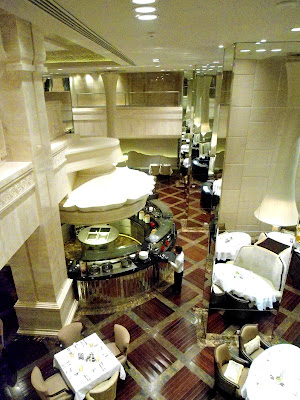 |
| A view of Madras Pavilion |
Vallavan is the north entrance, a drop off point for the Grand Raja Raja Chola Suite
or the Grand Presidential Suite guests and for ITC One. Guests get personalised check-ins here.
Sembiyan, the drop off facing the east, is the dedicated entrance for the high end luxury retail area – the Grand Luxe Street.
Killi, the drop off facing the south, functions as the entrance to the Chola Residences – the high end serviced apartments at ITC Grand Chola.
The grandest entrance, to the west, also serves as the main gate. This entrance is called the Chola drop off and leads to the Grand Stairway in the palatial lobby – Sangam.
The total quantity of marble used in the hotel is 92,000 square metres
The total quantity of external granite cladding is 12,000 square metres
The total external painted area is 15,000 square metres
An inhouse theatre, Kalai Theatre will be on 2,625 square feet with a seating capacity of 45 persons