Showing posts with label karnataka. Show all posts

Saturday, 7 September 2013

Escape to heaven on Earth...


Place: MADIKERI

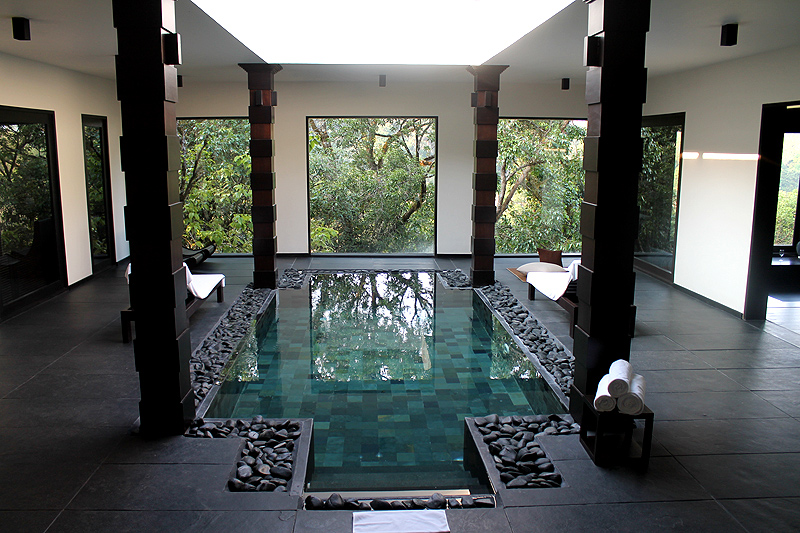
The spectacular pool in the reception building, located a level below the lobby, offers a matching view of the surrounding Coorgi countryside
Hotel: VIVANTA BY TAJ 

 ... and try to make it as long a break as you can. It will still seem short!

Wow.  That’s usually the most often used word first by anyone entering the Vivanta by Taj at Coorg. Or superb. Or stunning. Or sensational. Or simply a silence. You get the drift.

The morning mist hangs low over the surrounding hills,
a view that has to be seen to be believed
It’s not their fault. As any visitor can testify, that view has few parallels, helped by the fact that there are few places as beautiful as Coorg. Think of all the clichés – rolling hills, misty mountains, lush rainforests, verdant valleys, birdsong dawns, quiet getaways, and Coorg ticks every one of them. 

Combined with the best of amenities and service, no surprises then that Taj’s ambitious new Rs 150-crore, 180-acre property looks to set new benchmarks for luxury resorts in the country.

A different view of a different pool
Nestled deep in Coorg’s hills and forests at a height of about 4,000 feet, the Vivanta by Taj Madikeri brings a new level of luxury hospitality to the area. The vast property actually includes hills and fields within its expanse, and has just 56 villas or rooms – which means solitude is a default setting here. Every villa, situated on slopes, has a view, and the exterior architecture follows the local pattern of solid platform base, seen best at the fort in Madikeri.

The slopes mean that unless you want to get tired and / or lost, you have to use, or rather be driven in the golf carts, which zoom around all day, carting guests in every direction, the only downer here as you could have to wait on busy days. Even the GM Krishan Kant may possibly drive you! Passionate about the property, he points out the must dos in the resort.
The pool inside the 3,000 sqaure foot villas. You can't imagine
greater luxury, till you get to the 9,000 square foot villa!
The rooms are spacious, and start from the 850 square feet superior charm room to the exquisite 1,400 square feet premium indulgence room. For a lifetime’s memory try the 3,000 square feet luxury bliss villa, which comes with a plunge pool and balcony. The 9,000 square feet presidential villa is just wicked – do you want to get lost? The touch of Pramod Ranjan, Non-Executive Director, Oriental Hotels, whose dream project this has been, is evident in the smallest of details across the hotel. The furniture is dominated with clean lines, the baths are extravagant, and the lighting perfect, right down to the fish trap inspired lamps. Did I mention the fireplace? Yes, every room has one, for apparently winters are cold. Could this get more perfect!

Another view  of the magical mist, imbued in
 the colours of dawn
Greens, games, grub
Being green is a way of life here – right from the way villas have been built without cutting trees to the way resources such as water and energy are used within the hotel. Earth compound bricks were used, says Ranjan, who also got all furniture except for the ones at al fresco made on site from local hardwood.  “Accessibility to the site during construction was a challenge,” says Ranjan, who started work on the hotel in 2006, with Taj joining in a year later. Closeness to nature is evident in the seasonality of food, or the extensive forest walks on offer with resident nature expert Abhishek Jain, whose knowledge of the surrounding forests will make you stretch the walk for as long as you can. He can tell you which hills offer the best views, or where the tigers are most likely to frolic!

The forests are interspersed with rice fields, part of the vast property, and a venue for leisurely conducted walks
Actually a lot of activities are on offer. The start has to be made by the inhouse museum, which showcases Coorg – and is much better than the government one at Madikeri. Col Muthanna is on hand to show you around personally. Get a great introduction to Coorg from him. There’s a resident potter, sessions for coffee tasting, yoga retreats, mountain biking, nature trails, including walks to Nishanibetta Hills and even zip lining. There are excursions to the source of the Kaveri, which begins nearby or to the largest Tibetan settlement in India at Bylekuppa, or visits to the palaces of erstwhile royals or to spice and coffee plantations. Just outside the resort is a picturesque golf course. And of course there is a gorgeous infinity pool.

While the view from the lobby is spectacular, its
interior detailing is no less impressive
Another aspect of the resort you shall indulge in are its dining options. Given the isolated location, the nearest eatery outside the hotel is quite some distance away, so the hotel has probably chosen to offer some spectacular choices. 

Describing Fern Tree as an all day dining option would be gross disservice to it, given its lavish food options, with a free side dish of views. Many drive up just for that, it seems! 

The vast hotel is sprinkled with a traditional furniture such as this
 imposing Coorgi bed
A level above with the stunning Jiva spa, also in the main block but a level below the pool, is Dew, a wellness restaurant where food is not just healthy but delectable. An experience at Nellaki, with traditional Coorgi cuisine is unforgettable for its distinct aromas and flavours. There’s the almost concealed Hive Bar. A concealed candle lit table by a natural spring that has to be seen to be believed. Easily the most spectacular experience however is dining under a star lit sky at the Poolside Grill, which has its own adjacent bar as deep hills surround you, dotted to the east with the distant shimmering of lights of Madikeri.  

Resort service standards are generally high, and the staff here go all out to make the stay memorable. Already the setting for some expensive weddings, the resort has extensive conferencing facilities too. The resort seems to fit in more with Taj’s top line palace hotels. Step in for the Taj resort experience, and make your own one of a kind memories!

Captivating Coorg
 Sun rays streaming in. Such views make any length of journey worth its while! 
Coorg, or Kodagu, has not really been on the tourism map, especially for north Indians. It’s an average of seven hours drive from the most accessible wide body plane airport, Bengaluru. Now Mangalore is about fours away, but almost agree that is not the best option, especially as road conditions aren’t great. Mysore, just two hours by road, is such a famous domestic tourist destination, but unfortunately not on the aviation map yet in any proper way, though there is talk of the current airport being expanded. That could well make the area far more accessible.  

For forest walkers, coffee is arranged deep inside the forest!
Historically distinct from both Karnataka, which it is today a part of, and adjoining Kerala, Coorgis are said to have ancestral links with the Greeks. In any case their distinctness remains to this day, with many Coorgi families still with members in the Indian army. The Indian hockey team has rarely been without a Coorgi. Yes, they are good at actually playing sports. Think Cariappa, Thimayya, Ponnacha, Muthamma, Uthappa, Nachappa, Bopanna, Somaiya, Halappa...  

Even today in this predominantly agricultural region days are languid, and food and drink free flowing, and life pleasurably slow. Major plantations of coffee and spices abound, and there are a hundreds of homestays, many of whom are popular with the global tourist. Forests are within walking distance as are valley views of dawn and dusk and the green hours in between, but only if you walk up the invitingly gentle hills all around. For anyone seeking an escape from urban hustle, look no further.

Monday, 14 December 2009

Connecting over coffee


Place: CHIKMAGALUR

A coffee picker earns a rupee and a half per hour for his or her labour. At eight hours a day, it would still not be a whole number of even my unsubstantial salary. Yet I offered to do time at the Thirthagundi estate, one of the hundreds of coffee estates in the breathtaking Malnad region of Karnataka.

coffee beans
The coffee bean acquires a maroon shade as it ripens
A recent weekend trip to the Café Coffee Day (CCD)-owned plantation proved to be an eye opener in more ways than one. The 5 Senses Coffee Trail, a crash course in coffee appreciation—from its history to brewing it—was an educative and exhilarating experience, especially as the delightful Chikkamagaluru, or Chikmagalur weather complimented the stay. Incidentally, the town is on the periphery of the holiday map for the area, and CCD last year inaugurated what is arguably the resort destination in Karnataka, The Serai. But more on that elsewhere.

coffee country
Coffee in India usually grows in spectacularly beautiful countrysides
Coffee is said to have originated in Ethiopia in the ninth century when a Sufi monk discovered goats that consumed coffee cherries were more energetic than those that did not, says Dr Prakash Kenjige, Head, Research and Development, CCD. Amazing story, don't know how true.

Its fame and reputation spread and it remained a closely guarded secret of the Arab world till expanded trade and smuggling spread it to the rest of the world in the centuries where seafaring mercantilism was at its peak in those times.

How much coffee will grow on
this one?
In India, it is said that another Sufi saint, Baba Budan smuggled seven beans in his belly button and planted them in Chikmagalur in the 17th century, and the district to date remains the centre of coffee plantations in the country. Baba Budan is still revered in the area for his service, only violent competing claims by some Hindus and Muslims have led to a ban on any visits to his shrine—a Babri Masjid-like situation in south India.

Harvesting is fun!
Coffee grows best in cool tropical climates. In India, south Karnataka and Kerala produced the bulk of India’s 2,93,000 tonnes the production for last year.

Two major varieties are grown, Arabica and Robusta, though the former has greater value for exports. There are about 800 varieties in all though. And there are four crucial individuals in the journey from the plantation to your cup at a nearby cafe—the planter, roaster, blender and brewmaster. We would meet them all, we discovered.

Coffee, before the cup
Coffee drying at the plantation. The colour difference is according to how strong the coffee needs to be
The coffee plant requires about a year to grow from the seed, planted in nurseries. The saplings are then transferred in plantations, on average 1.8 hectares in India. The flowering season is in February, and the fruit takes about nine months to mature. While CCD, India’s largest owner of estate area with about 8,000 acres, grows its own coffee, it also buys from other plantations, says Dr Kenjige.

Coffee plantations are not just about coffee, we soon discovered. The plantations are dominated by tapering silver oaks and arecanut trees, both which are pruned by specialists who, to do that, do not climb each tree individually, but swing from one tree to another. Just watching them to do at heights of about 15 to 20 feet makes one dizzy. The forests abound in orchids, growing high in the hills. We did not just stop to watch lush green peppers, but bit into them immediately. Hot, but oh so fresh.

The ripe red coffee cherries are best for picking—note that unlike tea, which comes from leaves—coffee comes from fruit, making processing that much more difficult, points out the coffee lobby, combating the much greater popularity of tea in India. The cherry has few takers, as it is sweet in an unpleasant way. Apart from the civet of course, whose droppings make for the most expensive coffee in the world, at about $10,000 for a mere cuppa! Madonna never travels without it, one is told!

Inside the CCD factory
After harvesting, the coffee berries are transported immediately and the beans extracted either by wet (pulping) or dry (sun drying) methods. When the moisture content is about 11.5%—coffee experts know that by tasting, they are sent to the blender. Though CCD itself uses just one blend across its cafes, it makes 28 blends, many for sale outside the company.

Next came the roasting machines—three storey high machines that purred and whizzed and hissed almost unceasingly. And there’s a new one in the company. From there is was just a short step to packing, which involves special six-layered packs that let the heat escape but not the aroma, so that when you open the packet, you still smell fresh coffee. Don’t ask me how.

Ok, our efforts at brewing may not
pass your exacting standards,
but we were pretty proud
Felix Daniel Mathew, Manager, F&B, took us through the intricacies of brewing. We were meant to master the skill of not just making the perfect coffee, but also those beautiful hearts and flowers that top the cups!

We may not have got that right, but between learning the right fruit to pick to the right grinding proportions, a cup of coffee no longer remained just that. It is a work of art!

Wednesday, 9 December 2009

Tranquility

Place: CHIKMAGALUR

A view the Serai resort in Karnataka's Chikmagalur district.

The Serai consists of a number of individual villas and overlooks the ghats. It's a spectacular site in the middle of the coffee growing region. Water is an important facet in this Cafe Coffee Day owned resort, and a central channel flows right through.

This is an early morning shot over the central pool.  

Tuesday, 1 December 2009

Coffee country

Wild, tropical, green, a coffee plantation is a great
place to relax in
Place: CHIKMAGALUR

Deep inside a coffee plantation.

Comparisons with tea are inevitable. So well, unlike the perfectly manicured tea estates, coffee plantations are perfectly wild, as you can see. Coffee bushes are low, but they are usually set among high trees, including pepper, sliver fir and arecanut. The resultant combination is a wonderful mix of tall trees and creepers, beautiful shiny leaves and red brown coffee berries.

This photo is taken around noon time. Different times of the day have their play of light and shade. Do not be on a tight schedule when visiting!