Wednesday, 16 November 2011

Grand past, future uncertain

All set to set off from Ghum station, the highest in India. 
Place: GHUM

One of the most iconic symbols of Indian railways, the Darjeeling Himalayan Railway may be a World Heritage project, local politics has ensured that has come to at its worst ever.

The train / route has played such an important role in popular culture, especially at a time when Bengal and Calcutta were the centre of Indian elite. For well over a century, it has delighted generations of tourists as entire families would take the train to the matchingly beautiful destination of Darjeeling.

When it was listed by UNESCO in 1999, it became only the second railway to get that honour, though it has since been joined by two more routes in India alone.

The track passes through picturesque little towns, and from almost
within touching distance of houses! 
The 86-km route was commissioned in 1881, and has since been modified a number of times, usually to better align to the hill gradients, as it rises from 100 m above sea  level to 2,200 through a spectacularly beautiful countryside - starting with verdant forests of Sukna, meandering through low hills at first and then increasingly higher mountain towns. The towns it passes are lovely as well, with house balconies often adorned with flowers growing in polythene bags! The tea gardens, uniformly arranged, with narrow passages and colourful tea plucking ladies, add their own charm.

The steam engines chug along for the better part of the journey along Hill Cart Road, which connects Shiliguri to Darjeeling. As a child, my mother, who grew up in the tea estates of the region, remembers running along the train, and getting on and off at will, so slowly did it move in parts. The route is steep, and in parts the train goes through loops, of which the Batasia is most famous. There are even parts where it reverses to move forward. For many parts, it almost seems to pass through people's houses, and travelling on it can give the passenger a first look at hill homes of the region, up close.

Due to damages to the rail track, the Darjeeling
Himalayan railway currently operates only from
Kurseong to Darjeeling
There are many small stations, though Kurseong is the major halting station. Quaint names such as Ghum and Sonada are like dream towns, where the townspeople, used to stares from passengers, go about their lives without noticing the train much.

Today the Gorkhaland dispute has meant that most of the route is in disarray. The train only runs from Kurseong to Darjeeling as unrepaired tracks means the route upto Kurseong is no longer operational. The carriages require upkeep, and there are comparatively few tourists as people are unwilling to come to a politically disturbed area. However it continues to draw some tourists and railway enthusiasts. And despite the hard times, hardly any visitor goes away without leaving a part of his heart behind to this Himalayan heritage. 

Monday, 7 November 2011

Erotica, up close

646 sculptures cover the facade of the temple 
Place: KHAJURAHO

Khajuraho is known for its collection of 'free expression' sculptures. The Kandariyâ Mahâdeva Temple is the largest and most ornate of these medieval temples, and even has its 'erotica' tour.

Built about a thousand years ago, supposedly by Chandella ruler Vidyadhara, the main spire  of the eleventh century temple represents Mout Kailas (now in Tibet), while the surrounding spires are meant to represent other peaks.

The temple is not huge, rising 31 metres, but such intricate facade carving makes the head spin if you look intensely, even for a short while. Go up close and look up, and you will feel that you are looking up a mountain slope.

Today a UNESCO World Heritage site, this temples, and surrounding ones have been enclosed a protective enclosure, which if unimaginatively designed, at least is maintained decently. The green grass sets of the beige of the temples quite well, and once the risque remarks have been passed by companions/ passers by, take time out see this and its surrounding temples. For they are definitely a feat of architecture and imagination. And observation?  

Sunday, 6 November 2011

Mid morning stroll

NH 75 passes right through Panna, providing lots of opportunities 
to its residents go about their daily life in full public view
Place: PANNA

Elephants taking a mid morning stroll at the Panna National Park.

This pic was taken when returning from an assignment in Madhya Pradesh. NH 75 passes right through the national park, and it was a really rewarding stretch of an otherwise tedious journey. Once a tiger reserve, by 2007, authorities had seen to it that none survived. Today, some have been brought from other parks in an effort to recreate it as a tiger reserve.

However it is otherwise a rather pretty forest - teak and evergreens dominate, and the Ken flows through the park, making it a meeting point for lots of fauna, which includes hundreds of bird species.

Saturday, 22 October 2011

Navarino dreams

By the beach of our hotel
Place: MESSINIA

As I write this, the peak tourist season is just beginning in Greece. A country riddled with economic crisis, Greece nevertheless is the amongst the top choices to visit for many around the world. Tourism contributes about 15% of its GDP. Yet when I went last October, every person we spoke to was a little down, unsure of how they would sustain themselves. The intervening winter has only helped in minute doses. Somehow, I found Greece itself will have to shake things up a little. Wherever we did go, in Athens, or beyond, people are clearly worried – at the Plaka bars, in souvenir stores, by the Acropolis, cabbies in their taksis, in hotels – and it was a bit of a dampener.

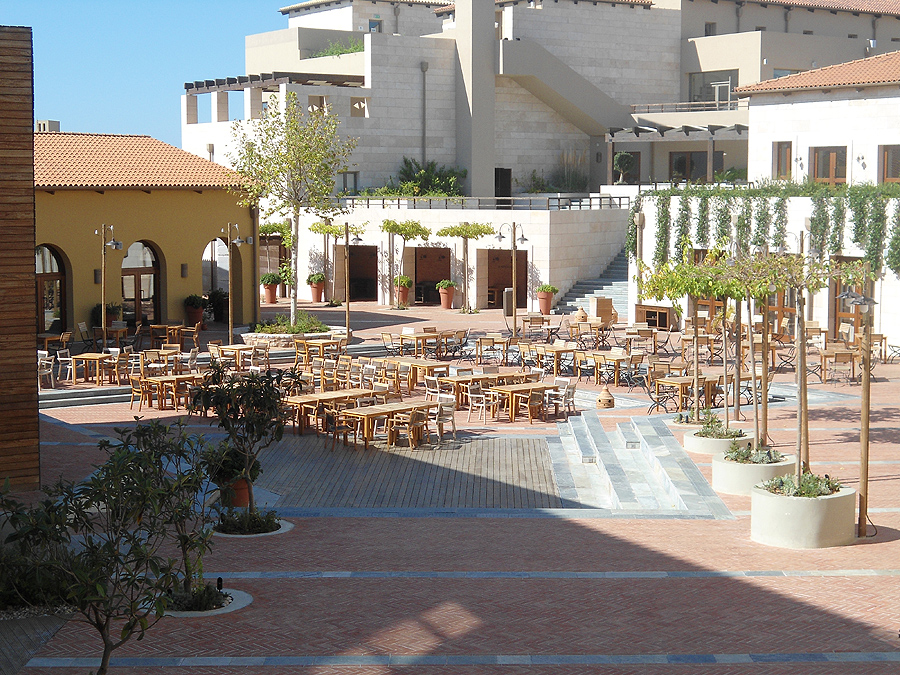
Part of the common area between the hotels.
On the left is a restaurant
It is such a beautiful country, and I was fortunate to experience the countryside as well due a longish drive, and every nook and cranny seemed alive to possibilities of people wanting to come and spend time to relax. With its sumptuous offering of world shaping history, ancient cities, exotic architecture, pristine beaches, magical islands, Med cuisine - the landscape is just what the traveler wants. It would be shame if it fell into disarray due to economic hardships.

Here are a few pics of a brief but extremely enjoyable stay at Costa Navarino, the new luxury resort that has been highly recommended by travel experts and might just be able to energize tourism into Europe again. Unfortunately I lost my camera midway, so no pics of Athens, but of course I am really glad to have seen it. Hope many more see it this season, contributing in their own way to reviving the economy, and bringing some smiles back.

Monday, 3 October 2011

Devi family

Durga in the middle with here children, from left to right - Ganesha, Lakshmi, Saraswati and Kartik. Works of art, today there are a many competitions to see who can make the best idols. And competition is fierce! 
Place: DELHI

It's that time of the year again - chuti from office, lots of food, pandel hopping, all kinds of finery, mughlai porota, parar baccha der natak, prosad bitoron, raate cinema dekha, shokaler anjoli and, I almost forgot, the customary nod to Durga and her progeny.

Durga Pujo is the most anticipated time of the year for Bengalis, wherever they are. It is held usually in October, and exact, as every date in the Hindu calendar, differs from year to year. 

This is a glimpse of the devi in a pandel in Delhi's Dwarka Sector 4. Such temporary idols of the the goddess spring up four days right across the city - there are thousands now, and all over the world where there are Bengalis, or Bongs. 

For those who enjoy it, these are four days of bonding as few other communities experience it. They look forward to it the entire year, and in less materially prosperous times, it was the time of the year when new clothes were bought and worn, new activities undertaken as it was an auspicious hour. And for some, it was also the time to go on vacations as a month long holiday in Bengal meant freedom to travel! 

Kolkata of course is where the biggest celebrations are, and the city grinds to a halt during those four days. There are thousands of pandels, and people constantly travel to see idols in different pandels, visit relatives and friends, renew bonds and come together to celebrate the goddess and each other.