Wednesday, 11 September 2013

Urban solitude

Place: DELHI

HOTEL: DUSIT DEVARANA

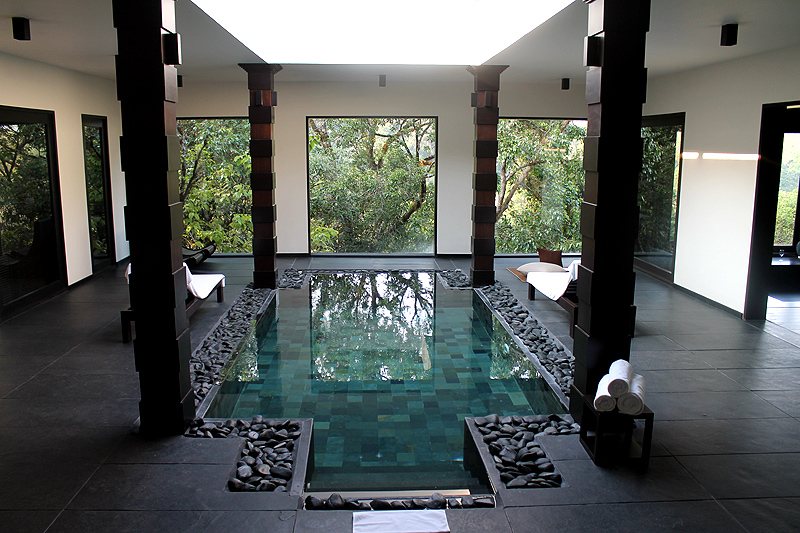
An uber luxury urban resort, the first in its kind in the National Capital Region, is how you are introduced to the hotel. Let’s see if the facts and features impress you. The resort is spread in about eight acres. This vast spread however has just 50 rooms, the average space per room is considerable. All rooms, and there are three categories of each, are sized 650 square feet each. Room amenities include all the clock butler service and iPads to control for all gadgets. There’s a 102 metre pool – that’s more than twice the length of an Olympic size pool,  between the blocks set amongst landscapes gardens. There are over a 1,000 trees on the property.

The entrance, though on the National Highway 8, is discreet, so be on a lookout for it. Design fans, start taking mental notes. The Thai colour for royalty, purple starts right here, and is woven into multiple facets of the hotel. You drive into a square, spacious courtyard, where guests are dropped off. Note the walls – besides acting as a sound barrier, their surface is covered with metal ficus leaves, in effect a huge art installation. The architect, the renowned Lek Bunnag, who has also done the Four Seasons Resort in Chiang Mai and Langkawi, the Sofitel So Mauritius and the Oberoi, Bali, besides the Trident, Gurgaon, has chosen to keep the interiors minimalist, creating spaces of serenity.

Wander further, and an imposing door opens to what is referred to as the ‘dome’ building. Though you won’t get a clear line of vision here – intentionally - pause a moment to take in the intricacies of design. Note the boat shaped marble tables, the strikingly hued glass panel, the net and glass topped ceiling, which filters light to reflect the different times of day creating shadow play, the beautiful moon doors, recessed niches and arches set in stone, clover leaf patterns – a motif that goes across the hotel. This area opens to a long pool with hugging greens and a family of friendly ducks!

Dusit Devarana is positioned as a luxury spa destination, says Ankur Bhatia, Executive Director, Bird Group. “We would like to serve the discerning tourist who wishes to enjoy a luxurious residence while in India.  The top-end of the corporate sector will love staying here too with our superb location near the airport and excellent, quick access to Gurgaon or important addresses in Delhi.”  

The built up area, just 2.6 acres, comes mainly in two blocks. The northern block, besides rooms, which include 11 Grand rooms that open to the pool, providing private access to it, also houses Lah. Though there is no official word on the expense incurred to develop the resort, just the fact that every detail has been minutely debated makes it a delight for the customer. Birgit Holm, General Manager, who has been on the project for the last two and half years, takes pride in pointing out details such as the beautifully carved door handles, moon doors or the bird topped receptacles in all rooms. Staff uniforms have been designed by designer Suneet Varma, and staff to guest ratio is about three and a half.

The outdoor pool is temperature controlled. The marble used is from Greece. Terrazzo has been widely used for surfaces, and there is a fair amount of work in bronze and brass, though largely understated. The design incorporates local motifs as well, as well as those from the past, including the Isfahani pillars in hardwood. All public areas have ceilings that are 25 to 30 feet high, helping to create a spacious feel, adds Jaideep Anand, AGM. The ambience for the property is uniquely serene for a bustling destination such as Delhi, though there are parts where the summer sun maybe a tad too much even for a short walk!

The southern block is fronted by a set of gigantic stone columns inspired by those at Elephanta caves, and open to a restaurant. Dining options include Kiyan, which offers world cuisine, and you will be grateful for leaving that diet behind during your stay, for Executive Sous Chef Nishant Choubey conjures up some magic on the table. There are no buffets, instead chef has opted for set meals delivered out of a no expenses spared fancy kitchen. Attention to detail is evident in each dish, both in presentation and the flavours. Expect charcuterie platters and quinoa! Add the amethyst wall and an exquisite metal tree by product designer John Bowman, and no surprises that this is likely to be the focal point of stays here.

Iah, the bar caters to younger clientele, offering trendy mixology options, boutique brewery beers and new age wines. An added destination will be Kai, the Mayfair London based Michelin starred restaurant serving Chinese cuisine. It is expected to open later this year. It’s going to be in an outdoor luxury tent next to the southern block.

With the Thai tradition to excellence to uphold for its spa, the azure and silver Mughal design themed Devarana Spa also has a lot riding on it. There is a block for meetings and conferences, though the hotel is quick to admit it will only be able to host up to a hundred or so people, ruling out the mega Indian wedding. A more intimate social function or top end corporate meeting is more the target.

Room interiors are as noteworthy - the designers have certainly pushed the envelope: many rooms feature a bathtub directly adjacent to the couch and the French windows, the day beds are enticing, the amenities are from Asprey’s Purple Line, the washbasins appear more like oversized flower vases.

The hotel has been about four years in the making, and is opening with a delay of about a year, less than average compared to hospitality projects in the country. Room rates for Dusit Devarana compete with the top end local hotels, though serving a very different clientele. Hospitality experts feel the hotel could set new benchmarks for urban resorts in India, though the current slowdown in the economy could impact its initial occupancy and room rates. 

Saturday, 7 September 2013

Escape to heaven on Earth...


Place: MADIKERI

The spectacular pool in the reception building, located a level below the lobby, offers a matching view of the surrounding Coorgi countryside
Hotel: VIVANTA BY TAJ 

 ... and try to make it as long a break as you can. It will still seem short!

Wow.  That’s usually the most often used word first by anyone entering the Vivanta by Taj at Coorg. Or superb. Or stunning. Or sensational. Or simply a silence. You get the drift.

The morning mist hangs low over the surrounding hills,
a view that has to be seen to be believed
It’s not their fault. As any visitor can testify, that view has few parallels, helped by the fact that there are few places as beautiful as Coorg. Think of all the clichés – rolling hills, misty mountains, lush rainforests, verdant valleys, birdsong dawns, quiet getaways, and Coorg ticks every one of them. 

Combined with the best of amenities and service, no surprises then that Taj’s ambitious new Rs 150-crore, 180-acre property looks to set new benchmarks for luxury resorts in the country.

A different view of a different pool
Nestled deep in Coorg’s hills and forests at a height of about 4,000 feet, the Vivanta by Taj Madikeri brings a new level of luxury hospitality to the area. The vast property actually includes hills and fields within its expanse, and has just 56 villas or rooms – which means solitude is a default setting here. Every villa, situated on slopes, has a view, and the exterior architecture follows the local pattern of solid platform base, seen best at the fort in Madikeri.

The slopes mean that unless you want to get tired and / or lost, you have to use, or rather be driven in the golf carts, which zoom around all day, carting guests in every direction, the only downer here as you could have to wait on busy days. Even the GM Krishan Kant may possibly drive you! Passionate about the property, he points out the must dos in the resort.

The pool inside the 3,000 sqaure foot villas. You can't imagine
greater luxury, till you get to the 9,000 square foot villa!
The rooms are spacious, and start from the 850 square feet superior charm room to the exquisite 1,400 square feet premium indulgence room. For a lifetime’s memory try the 3,000 square feet luxury bliss villa, which comes with a plunge pool and balcony. The 9,000 square feet presidential villa is just wicked – do you want to get lost? The touch of Pramod Ranjan, Non-Executive Director, Oriental Hotels, whose dream project this has been, is evident in the smallest of details across the hotel. The furniture is dominated with clean lines, the baths are extravagant, and the lighting perfect, right down to the fish trap inspired lamps. Did I mention the fireplace? Yes, every room has one, for apparently winters are cold. Could this get more perfect!

Another view  of the magical mist, imbued in
 the colours of dawn
Greens, games, grub
Being green is a way of life here – right from the way villas have been built without cutting trees to the way resources such as water and energy are used within the hotel. Earth compound bricks were used, says Ranjan, who also got all furniture except for the ones at al fresco made on site from local hardwood.  “Accessibility to the site during construction was a challenge,” says Ranjan, who started work on the hotel in 2006, with Taj joining in a year later. Closeness to nature is evident in the seasonality of food, or the extensive forest walks on offer with resident nature expert Abhishek Jain, whose knowledge of the surrounding forests will make you stretch the walk for as long as you can. He can tell you which hills offer the best views, or where the tigers are most likely to frolic!

The forests are interspersed with rice fields, part of the vast property, and a venue for leisurely conducted walks
Actually a lot of activities are on offer. The start has to be made by the inhouse museum, which showcases Coorg – and is much better than the government one at Madikeri. Col Muthanna is on hand to show you around personally. Get a great introduction to Coorg from him. There’s a resident potter, sessions for coffee tasting, yoga retreats, mountain biking, nature trails, including walks to Nishanibetta Hills and even zip lining. There are excursions to the source of the Kaveri, which begins nearby or to the largest Tibetan settlement in India at Bylekuppa, or visits to the palaces of erstwhile royals or to spice and coffee plantations. Just outside the resort is a picturesque golf course. And of course there is a gorgeous infinity pool.

While the view from the lobby is spectacular, its
interior detailing is no less impressive
Another aspect of the resort you shall indulge in are its dining options. Given the isolated location, the nearest eatery outside the hotel is quite some distance away, so the hotel has probably chosen to offer some spectacular choices. 

Describing Fern Tree as an all day dining option would be gross disservice to it, given its lavish food options, with a free side dish of views. Many drive up just for that, it seems! 

The vast hotel is sprinkled with a traditional furniture such as this
 imposing Coorgi bed
A level above with the stunning Jiva spa, also in the main block but a level below the pool, is Dew, a wellness restaurant where food is not just healthy but delectable. An experience at Nellaki, with traditional Coorgi cuisine is unforgettable for its distinct aromas and flavours. There’s the almost concealed Hive Bar. A concealed candle lit table by a natural spring that has to be seen to be believed. Easily the most spectacular experience however is dining under a star lit sky at the Poolside Grill, which has its own adjacent bar as deep hills surround you, dotted to the east with the distant shimmering of lights of Madikeri.  

Resort service standards are generally high, and the staff here go all out to make the stay memorable. Already the setting for some expensive weddings, the resort has extensive conferencing facilities too. The resort seems to fit in more with Taj’s top line palace hotels. Step in for the Taj resort experience, and make your own one of a kind memories!

Captivating Coorg
 Sun rays streaming in. Such views make any length of journey worth its while! 
Coorg, or Kodagu, has not really been on the tourism map, especially for north Indians. It’s an average of seven hours drive from the most accessible wide body plane airport, Bengaluru. Now Mangalore is about fours away, but almost agree that is not the best option, especially as road conditions aren’t great. Mysore, just two hours by road, is such a famous domestic tourist destination, but unfortunately not on the aviation map yet in any proper way, though there is talk of the current airport being expanded. That could well make the area far more accessible.  

For forest walkers, coffee is arranged deep inside the forest!
Historically distinct from both Karnataka, which it is today a part of, and adjoining Kerala, Coorgis are said to have ancestral links with the Greeks. In any case their distinctness remains to this day, with many Coorgi families still with members in the Indian army. The Indian hockey team has rarely been without a Coorgi. Yes, they are good at actually playing sports. Think Cariappa, Thimayya, Ponnacha, Muthamma, Uthappa, Nachappa, Bopanna, Somaiya, Halappa...  

Even today in this predominantly agricultural region days are languid, and food and drink free flowing, and life pleasurably slow. Major plantations of coffee and spices abound, and there are a hundreds of homestays, many of whom are popular with the global tourist. Forests are within walking distance as are valley views of dawn and dusk and the green hours in between, but only if you walk up the invitingly gentle hills all around. For anyone seeking an escape from urban hustle, look no further.

Wednesday, 14 August 2013

Party with the rich


Place: DELHI
Pangaea’s entry into India brings elite party level closer home

This is Michael Ault’s 89th club opening. He asserts this is his best yet. Ault’s penchant for opening top end clubs has seen him being labeled as the ‘king of New York nightlife’. While the Pangaea in New York is no longer open, it was the byword for being the ‘hottest party in town’, attracting a heady mix of wealth and celebrity as they let their collective hair down. The opening of a underwater branch at a spectacular ‘crystal’ island at Singapore’s Marina Islands about two years ago brought the ‘ultra-lounge’ so much closer home for India’s jet set.

Here’s a little known facet of Pangaea, Singapore. About 30 per cent of entrants to the Singapore Pangaea are Indians, the largest number by nationality, say club spokespersons. It was no surprise that Ault was more than willing to come to India. The club in Delhi has just opened at Delhi’s ITDC run Ashoka hotel, and a second one is slated to start in a hotel in Juhu, though the group is coy in naming the exact location!

Old wealth, new skins
Ault, 50, and a collector of rare Louis Vuitton handbags and an avid scuba diver is no playboy. Born to old money, his chosen business happens to be clubs, which he started after a six-year stint at Wall Street. These clubs, and besides Pangaea, he also owns Spy, Chaos, MercBar, Prive and Nocturne, are reputed to be some of the top revenue earners in business that is notoriously fickle as the clientele shifts to latest hotspot periodically. The average per head spend at Pangaea is anywhere from $400 to $1,000, says Ault. Pangaea Singapore earned $21 million in the first year of operations.

He is most bullish on India, saying the kind of money that Indians spend often amazes him. “You have to look at them twice to believe it,” he says.. While neither he nor Ozi Amanat, President and Chief Investment Officer, Spice Global, the BK Modi owned conglomerate that is now spreading beyond telecom, will reveal the exact spend, most estimate it to have cost ‘an arm and a leg’ metaphorically! Spice signed a one year contract with Pangaea, and Amanat says the scoping and benchmarking process has left him confident that India’s first taste of a global nightclub will work wonders for the bottomline.

“We can recover money very very fast in this business,” says Amanat. A week into opening, he is already pleased with the returns from the 6,000 square feet club, (F-Bar was previous occupant of the space) with seating for about 250 people, with  and another 250 standing. “There is no separate floor for dancing,” explains Amanat, as is the club’s practice elsewhere. “People can dance where they like, and keep ordering drinks!” Splurging will come easier for the ‘loaded’ in India. The top entry price is Rs 4 lakhs, though considerably lower entry fees also exist! The Jewel of Pangaea cocktail in Singapore costs about $28,000, and Amanat says there will a signature one like that in India soon! 

If that doesn’t keep it in the limelight, an impressive line of events including a DJ KasKade night should ensure to make it a much sought after ‘watering hole’ for the city for quite a while. A dozen hostesses from different geographies adds to exotic element, while a number of innovations including soundproof walls. Amanat is aware of the challenges, such as early closing times in India, but is confident that the club will do well. Indians eat post clubbing so the available menu that ranges from chicken tikkas to mini wagyu burgers could be expanded. Private events are also expected to shore up revenues. There are no plans to expand beyond Delhi and Mumbai, but once inside Pangaea, India’s partygoers could be forgiven for thinking they were in a more global party capital such as New York, London or Miami.

Monday, 5 August 2013

Near pavilions


The Thai Pavilion is decked in warm, welcoming colours 
Place: GURGAON 

Restaurant: THAI PAVILLION

Thai Pavillion is a welcome addition to Gurgaon’s considerable culinary space

Almost two decades after the first Thai Pavilion opened its doors at Mumbai’s Taj President, it forever altered that city’s appreciation for Thai delicacies. Now its latest edition is set to usher in a similar sweep in shiny-shabby Gurgaon’s swanky Vivanta by Taj, where the latest edition of the Pavilion has just opened. The newest edition of the restaurant, the third, after a Pavilion at Vivanta in Hyderabad’s Begumpet, also marks the first north Indian foray for the outlet.

Kai haw bai toey, marinated chicken morsels wrapped in
pandan leaves and fried
The same high standards still apply, still under eagle eyes of Executive Chef Ananda Solomon, whose success with this brand for long was a model to emulate for specialty restaurants at top end hotels. Well chef is personally in Delhi about once a month, and the team here has trained with him in Mumbai extensively. Additionally, there is a diminutive and dazzling and thankfully English speaking Thai Master Chef Prajaub Shoosridam, spending long hours in the kitchen and frowning at no chillies and other such customization requests. Yes, you are guaranteed an authentic Thai flavour here.

The wonderfully tangy Som tam, Young papaya salad combined
with sweet and spicy sauce
Nevertheless every day there are tests that must be passed successfully. A nod to Delhi’s local client palate means there is a comparatively greater stress on red meats, and well meats in general than the other outlets, but then Hyderabad is spicier. Solomon says a proper study was done of trends in Delhi before finalizing the menu. “You can’t Indianise the concept,” chef stresses. “Thai restaurants have to be authentically handled. The right combinations have to be achieved, right from the starters to the main course. Solomon is known for his adherence to the classic traditions of cuisine, be it his native Konkani or in the successful restaurants he has launched in cuisines as different as Thai and Italian.

The 80-cover Thai Pavilion carries forward the traditions of its cousins – most of the ingredients still fly in from Thailand to Mumbai and then get distributed to Hyderabad and Delhi. While chicken is an exception, almost everything else from lamb to rambutan and dragon fruit to pandan leaves, condiments and even a variety of chillies all fly in twice weekly.

The famous Thai curries - red and green, with steam rice
The menu is fairly extensive, and starters after the lovely pomegranate based welcome drink, include Sakuna chowsuan sos makam (Tempura prawns with tamarind sauce) and Kai haw bai toey (marinated chicken morsels wrapped in pandan leaves and fried), but the best choices by far are the tangy Som tam (Young papaya salad combined with sweet and spicy sauce) and Pra hed (mushrooms delicately blended with Thai herbs). There’s a vast choice of main courses, including many vegetarian ones. Apart from the most familiar, and ordered red and green curries – delicious by the way – try the Heao phad prik haeng (Water chestnuts and cashew nuts with red chili paste) or the Pia Nueng Manao (Steamed John Dory with coriander, chilly, peanut in a tangy sauce).

The restaurant itself is spacious, has a waiting lounge, which in the near future could we well used, given the restaurant’s popularity and fairly affordable pricing. Traditional Thai motifs are present and yet subtle, and the one that can become two PDRs, or private dining rooms offer a greater degree of privacy for groups. While Taj will not say how much it cost – Solomon says finding the right young people who are ready to spend long hours in the kitchen is getting harder – and a challenge for the entire sector.

Try the lovely Tub Tim Grob, Diced water chestnut with coconut milk, a dessert that will leave you
yearning for more
For those not yet favourably inclined to oriental desserts, make an exception and save space for the delectable Tub Tim Grob (Diced water chestnut with coconut milk), which is served in a scooped out raw coconut and comes with ice cream and chocolate rolls, if you like. You will ask for a refill even if you are stuffed! Or return for another helping!  

Monday, 15 July 2013

It’s a sellou(t)


PlaceGURGAON 

The warn interiors are evocative of the
 legendary Moroccan city
Restaurant: CASABLANCA

Moroccan cuisine makes a stylish entry to NCR

North Indian men are notorious for being food ‘loyalists’. Fill them with butter chicken or rajma chawal, and you can work out a much better deal. Deny the same, and suddenly lack of cultural connects become an issue, even if you are from just south of the Vindhyas, not to refer to the wider world beyond. For decades since independence, Delhi’s culinary landscape, even top end restaurants in hotels, had to balance global cuisines with more local tastes. It is very recently that increased travel, and possibly more choices as well as a sense of novelty have widened the acceptability levels, and new cuisines are coming up.

Lamb tagine - yes served in its
ubiquitous platter too
A wonderful beginning for Moroccan cuisine has been made by a restaurant called, what else, but Casablanca. Located at one end of Gurgaon at the new Double Tree by Hilton, the restaurant actually has a Moroccan resident chef, Rashid Choukki, who has planned an extensive menu, albeit with the considerable presence of dishes from all across the Mediterranean. The restaurant is also the first by the global hospitality chain to offer Moroccan cuisine, say the staff! Surely they must mean outside Morocco.

A largish restaurant housed in a separate building of its own, it has about 100 covers, including outside seating. The interiors are welcoming, the décor motifs and hues suitably evocative of the legendary Moroccan town it is named after, complete with lamps - from huge brass ones to lit ones in brightly coloured glass, beautiful ceramic tagines, heavy drapes overlooking a verdant treescape and sofas that invite you sink into their comfortable depths. Add a welcoming drink of Moroccan mint tea, and for a moment one could forget the concrete town outside. There are little cabanas that make for a more private seating, and they are weather proofed, providing heat and coolness as required.

Chicken pastillas - succulent and right spiced!
A beautiful menu invites you to start the proceedings. A novelty is a bowl of delicious almond filled dates, accompanied by small cups of orange blossom flavoured milk. It’s complimentary, and may be a bit of an acquired taste for some. This is followed by stuffed breads accompanied by a hallmark of the cuisine – its varied and delicious dips, including the famous harissa but also the hummus, babaghanoush and zaalouk. 


Prawns pil pil. Again, delectable
All excellent, and you could be forgiven for finishing a meal with these alone. A popular menu choice is the pastilla, a traditional slow cooked meat dish combining sweet and neutral or savoury flavours of onions, herbs and spices, chilled overnight. After adding eggs and toasted almonds, it is covered by layers of phylo pastry and finally topped with powdered sugar and cinnamon.  

While Moroccan cuisine uses a lot of spices, the combination with food is very different from the way it happens in India, and like the rest of the Arabic world, sweet and savoury is a common combination. 


Vegetable cous cous: An excellent veg option
Cold salads, usually differing combinations of onions, tomatoes, peppers, eggplants, garlic, greens and seasoning are followed by a tagine, a rich, slow cooked stew, both of meats and vegetables, often combined, that comes in its own pot. On offer are the more usual lamb or chicken tagine, but also more exotic seafood or even quail, rabbit or veal tagines! 

Two veggie options are listed too. The outlet actually offers main dishes after this, but be warned, normal appetites are only going to manage a tagine or a main such as moussaka, an eggplant based dish that is simply too good to be ignored. The adventurous may opt for khlea, dried lamb or beef, samak makli, assorted fried fish, though there are lovely grills as well.

You wouldn’t really have space for desserts if you tucked in earlier, but probably just as well. The traditional Moroccan desserts are fruits, though a variety of sweets, including traditional options such as sellou, but a brisk walk would probably serve you best! Take time out when you go, and let Casablanca weave its considerable magic.